 Calix
Description
The body is then explosively pulled up by the arms in a radial pull-up, with greater speed than a regular pull-up. When the bar approaches the upper chest, the wrists are swiftly flexed to bring the forearms above the bar. The body is leaned forward, and the elbows are straightened by activating the triceps. The routine is considered complete when the bar is at the level of the waist and the arms are fully straight.
To dismount, the arms are bent at the elbow, and the body is lowered to the floor, and the exercise can be repeated.
As a relatively advanced exercise, muscle-ups are typically first learned with an assistive kip. The legs swing (kip) up and provide momentum to assist in the explosive upward force needed to ascend above the bar. More advanced athletes can perform a strict variation of the muscle-up which is done slowly, without any kip. This variation begins with a still dead hang and uses isometric muscle contraction to ascend above the bar in a slow, controlled fashion.
Muscles
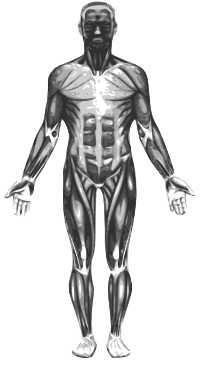


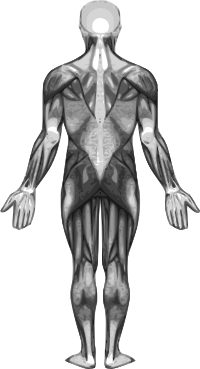


Primary muscles
- Biceps
- Lats
Secondary muscles
- Front deltoid
- Triceps
Similar exercises
Build your plan with Calix
Calix's AI coach builds your workout and meal plan, and you log your training. Free on Android and iPhone.
Description and images from the open wger exercise database, licensed CC BY-SA 4.0 (authors: clafal, wger.de, arson). Translations by Calix are shared under the same license. Muscle diagrams: wger project (AGPL-3.0).